
Legal Guidelines for Web Scraping in the EU 2026
TL;DR: Legal Guidelines for Web Scraping in the EU start with one rule: scraping public web data is not automatically illegal, but the project must comply with GDPR, database rights, website terms, copyright rules, and national enforcement differences.
This guide is written for data analysts and legal compliance officers who need to approve, design, or audit scraping workflows before data collection starts. You’ll get a practical framework for separating lawful public-data collection from high-risk scraping, including how to assess personal data, pseudonymized data, database extraction, request behavior, website terms, and AI training use cases.
Introduction to Web Scraping in the EU
Web scraping in the EU is the automated collection of website data, and its legality depends on what is collected, how access occurs, and whether the data qualifies as personal data under GDPR.
Key takeaway: public availability does not remove compliance duties. GDPR defines “processing” as any operation on personal data, which means collecting, copying, storing, structuring, enriching, deduplicating, analyzing, sharing, or deleting scraped personal data can trigger GDPR obligations even before the dataset is used commercially.
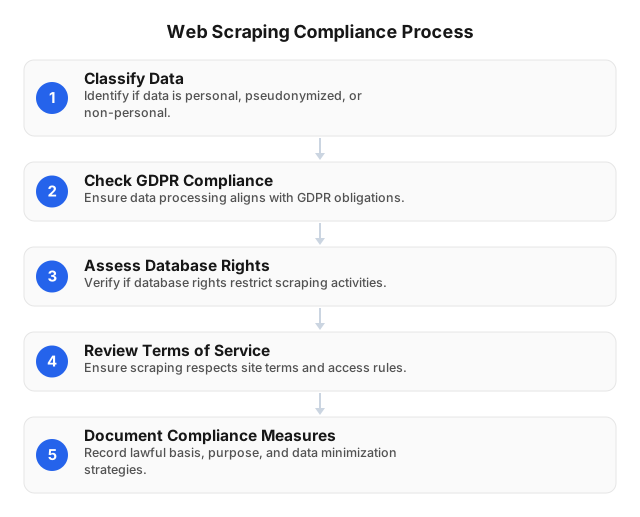
For analysts and compliance teams, the first legal filter is data classification:
- Low-risk scraping: product prices, public stock status, weather data, or non-personal corporate facts.
- Higher-risk scraping: names, profile URLs, photos, emails, job histories, device identifiers, or pseudonymized records.
- Red-flag scraping: logged-in areas, paywalled content, technical access controls, or collection that contradicts website terms.
Treat EU scraping as a governed data-processing workflow, not a simple extraction task.
Understanding GDPR and Its Impact on Web Scraping
Once a workflow may touch personal data, the question is not “Can the crawler access the page?” but “Can the dataset identify an EU person directly or indirectly after extraction, enrichment, or matching?” Relevant fields can include names, emails, usernames, profile URLs, device IDs, location signals, and combinations of data points.
Pseudonymized data still falls under GDPR if re-identification remains possible through a key, external dataset, or reasonable matching. Hashing emails, replacing names with IDs, or storing profile URLs separately can reduce risk, but it does not remove the compliance duty.
Before scraping personal data, document:
- lawful basis, such as legitimate interest with a balancing test;
- purpose limitation and retention period;
- data minimization rules at field level;
- objection and deletion workflow;
- safeguards for AI training or profiling use cases.
These GDPR controls sit alongside a second EU-specific issue: whether the target website is also a protected database.
Database Rights and Their Relevance to Web Scraping
EU database rights can restrict web scraping even when the scraped records contain no personal data and the page is publicly accessible. Legal scraping must satisfy 2 separate checks: GDPR for personal data and database rights for protected collections.
The EU sui generis database right protects a database maker’s substantial investment in obtaining, verifying, or presenting data. A product catalog, property listing index, job board, or pricing directory may qualify if the value lies in the curated collection, not just individual facts.
For compliance review, separate these cases:
- Lower risk: collecting a small, non-systematic sample for price validation, with attribution controls and retention limits.
- Higher risk: extracting a substantial part of a database, repeatedly harvesting changing listings, or recreating a competing searchable dataset.
- Red flag: using proxies, schedulers, or distributed workers to intensify extraction after access limits or website terms object.
Document purpose, volume, frequency, fields collected, and whether the output substitutes for the source database.
Legal vs. Illegal Web Scraping Practices
In practice, EU web scraping crosses into illegal territory when collection breaches 3 boundaries: personal-data misuse, protected database extraction, or unauthorized/abusive access. The table below turns those legal categories into operational review points.
| Practice | Usually lower-risk when… | Higher-risk or illegal when… |
|---|---|---|
| Public page scraping | Data is non-personal, non-copyrighted, and collected at a reasonable rate. | Data includes identifiable people and no GDPR lawful basis, notice strategy, or retention limit exists. |
| Personal data collection | The team documents purpose, minimization, lawful basis, objection handling, and deletion workflows. | Pseudonymized profiles are treated as “anonymous”; under GDPR, pseudonymized personal data still remains regulated. |
| Database extraction | Queries capture small, necessary portions for analysis. | Scraping copies or reconstructs a substantial protected database. |
| Website terms | Scraping respects contractual limits, robots.txt signals, and access rules. | The scraper ignores explicit prohibitions, logins, paywalls, or technical controls. |
| Request behavior | Traffic is rate-limited and does not impair service. | Overloading systems or circumventing access controls can trigger civil claims and, in serious cases, cybercrime charges under EU national laws. |
Compliance Strategies for Web Scraping
A defensible EU scraping program should start with 2 controls: lawful access and lawful processing. Key takeaway: a technically successful scrape is still unlawful if consent, legitimate interest, database rights, or website access rules are ignored.
- Map the data before collection. Classify each field as personal data, pseudonymized data, copyrighted content, database-protected material, or non-personal commercial data.
- Define the GDPR lawful basis. Use consent where the data subject has opted in; use legitimate interest only after documenting necessity, proportionality, and opt-out handling.
- Respect robots.txt and website terms. Treat robots.txt, rate limits, login walls, and contractual restrictions as access-governance signals, not technical obstacles.
- Minimize and expire data. Collect only required fields, hash identifiers where possible, and set retention dates before deployment.
- Throttle requests. Use distributed infrastructure to reduce load, not to evade rules; see ethical proxy use.
The same controls apply differently depending on the project. The following examples show how small design choices can move a scrape toward or away from compliance.
Case Studies: Successful and Unsuccessful Scraping Attempts
EU scraping outcomes usually turn on 3 facts: whether personal data is collected, whether database extraction is substantial or repeated, and whether the scraper respects access terms and server load. The safest projects document purpose, minimization, opt-out handling, and rate limits before the first request.
Successful: public price monitoring with minimization
A retail analyst collecting product names, prices, stock status, and timestamps from public pages has a stronger compliance position when the dataset excludes customer reviews, seller contact details, and account-only pages. The legal file should show a non-personal-data purpose, database-rights review, robots.txt/website terms assessment, and request pacing that avoids service disruption.
Unsuccessful: AI training dataset with profile data
A higher-risk case is scraping public profiles for AI model training, then retaining names, photos, bios, and inferred attributes without notice, lawful-basis analysis, objection handling, or deletion workflow. Pseudonymizing identifiers does not remove GDPR duties; it only reduces exposure if re-identification controls are real and documented.
Future Trends in EU Web Scraping Regulations
EU web scraping regulation in 2026 is moving from “can we collect this?” to “can we prove lawful purpose, data minimization, opt-out handling, and downstream control?” The key trend is evidence: compliance teams will need audit-ready records for each crawl, not just a one-time legal memo.
The newest pressure point is generative AI. European data protection guidance now treats scraping for AI training as a separate risk area, especially where personal data, special-category data, children’s data, or profile enrichment may enter a training corpus. Analysts should expect stricter review of source selection, retention periods, exclusion lists, and deletion workflows.
Database-rights enforcement will also become more operational. Repeated extraction from the same EU database, even in small batches, can look like systematic reuse if the pattern substitutes for the original service.
Practical 2026 controls:
- Log target URL, purpose, legal basis, data fields, and retention period per job.
- Maintain suppression lists for domains and data-subject objections.
- Separate AI-training datasets from market-intelligence datasets.
- Review proxy rotation against target terms, not only technical performance: ethical proxy use.
FAQ
What is the GDPR's role in web scraping?
The GDPR governs web scraping whenever the collected data can identify a person directly or indirectly, including names, profile URLs, photos, usernames, job titles tied to individuals, device identifiers, and some combinations of location or behavioral data. The practical test is not whether the page is public; it is whether your collection, storage, enrichment, sharing, or deletion workflow counts as “processing” personal data under EU data protection rules. For compliance review, document the lawful basis, purpose limitation, minimization rule, retention period, data subject rights process, and whether pseudonymized records can still be linked back to a person.
Are there penalties for illegal web scraping in the EU?
Yes. Illegal scraping in the EU can trigger GDPR enforcement, database-rights claims, copyright claims, contract claims for breaching website terms, and in aggressive cases, computer misuse or cybercrime allegations if the activity overloads systems or circumvents access controls. GDPR penalties can reach the higher tier set by the regulation, and civil exposure can also include injunctions, deletion orders, damages, legal costs, and loss of access to the target platform. A compliance officer should treat high-volume scraping, personal-data collection, and ignored opt-outs as separate risk multipliers rather than one generic “scraping risk.”
How can I ensure my web scraping is legal?
Start with a written scraping assessment before collecting data: identify the data fields, classify personal vs. non-personal data, review the website’s terms, check database-right and copyright exposure, define a lawful basis if GDPR applies, and set rate limits that do not impair the target service. Build operational controls into the crawler, including robots.txt review, request throttling, source logging, deletion workflows, and an objection or suppression list for data subjects or excluded websites. For proxy-based collection, use infrastructure to distribute compliant public-data requests responsibly—not to evade access controls—and keep audit logs showing the purpose, scope, and retention settings for each crawl.
What are database rights in the EU?
EU database rights protect a database when there has been substantial investment in obtaining, verifying, or presenting its contents, even if individual records are not protected by copyright. Scraping can create legal risk when it extracts or reuses a substantial part of a protected database, or repeatedly takes smaller parts in a way that conflicts with the database maker’s investment. A practical safeguard is to assess whether your crawl targets isolated facts, a small sample, or the core value of a structured directory, marketplace, listing site, or searchable archive.
Can web scraping be used for AI training legally?
Web scraping for AI training can be legal in the EU, but the compliance burden increases because training datasets often combine copyrighted material, personal data, and large-scale automated collection. For personal data, teams need a GDPR analysis covering lawful basis, transparency, minimization, retention, data subject rights, and whether pseudonymization is reversible or linkable. For copyrighted or database-protected material, AI teams should review text-and-data-mining rules, rights reservations, website terms, and whether research-institution exceptions apply to the specific project.
Is public web data automatically safe to scrape in the EU?
No. Public availability does not remove GDPR, copyright, database-right, contract, or cybersecurity obligations. A public LinkedIn-style profile, for example, may still contain personal data, while a public product catalog may raise database-right issues if the crawl copies the structured dataset at scale. Treat “public” as an access fact, not a legal clearance.
Do EU rules allow scraping for academic or research purposes?
EU law can give research institutions stronger footing in some text-and-data-mining and public-interest contexts, but the protection depends on the institution, purpose, dataset, and safeguards. Research teams should still document necessity, minimize personal data, respect valid rights reservations where applicable, and separate raw collection data from analysis outputs where possible. If the project uses vendors, proxies, or cloud processing, the compliance file should also cover processor roles, cross-border transfers, and deletion timelines.
This article was written by the EProxies team and reviewed against our editorial quality standards before publishing.